The Architecture of Freedom
Authenticity, Creativity, and the Breaking of Habitual Patterns
I have spent a lot of time thinking about behavior and how easy it is to fall into the belief that behavior is all there is.
It is, after all, the part of us that other people can see most clearly. Behavior is what gets observed, documented, praised, punished, rewarded, diagnosed, and remembered. It is what gives us some of our greatest joy and causes some of our deepest pain. Behavior gets us into trouble, and changing our behavior is often what helps us begin finding our way out.
So it makes sense that behavior receives so much of our attention. When something is going wrong in a life, a family, a classroom, a treatment program, or an organization, we naturally look at what people are doing. We ask them to stop, start, improve, comply, try harder, make better choices, or exercise more discipline. Sometimes that is exactly what is needed. There are behaviors that must stop before anything else can begin.
But the longer I have worked with people, and the more honestly I have looked at my own life, the less convinced I have become that behavior is where the story begins.
By the time a behavior becomes visible, a great deal has often happened beneath it. Something occurred. We interpreted what it meant. Emotion entered the experience. The present moment touched something older, perhaps a memory, a fear, an expectation, or a way of protecting ourselves that we learned long before we had language for it. A response began taking shape, and often it did so before we had much opportunity to consider whether that response still belonged in the life we are living now.
This is especially difficult to see when the response has worked before.
Maybe withdrawing protected us when speaking honestly did not feel safe. Maybe control created order in a life that once felt unpredictable. Maybe pleasing other people helped us remain connected to people we could not afford to lose. Maybe anger gave us access to a sense of power when we otherwise felt powerless. Maybe escaping was the only way we knew to quiet something we did not yet know how to carry.
We repeat these responses because, at some point, they made sense. Then we repeat them long enough that we stop experiencing them as responses at all. They begin to feel like personality. We say, “That is just how I am,” when what we may actually mean is, “That is what I learned to do.”
I keep returning to the difference between those two statements.
If something is simply who I am, there is not much room to move. I can defend it, hide it, apologize for it, or spend my life fighting against myself. But if it is something I learned to do, then I can begin asking when I learned it, what it has been doing for me, and whether I still need it to do that job in the same way.
That question has changed the way I understand freedom.
I do not mean freedom as an abstract idea, and I do not mean the freedom to do whatever we want. I mean something much closer to ordinary human experience. Something happens. I feel the old response beginning to rise. I know where it usually takes me. But this time, it is not the only response I can see.
There is enough room between what happened and what I do next for me to participate in the decision.
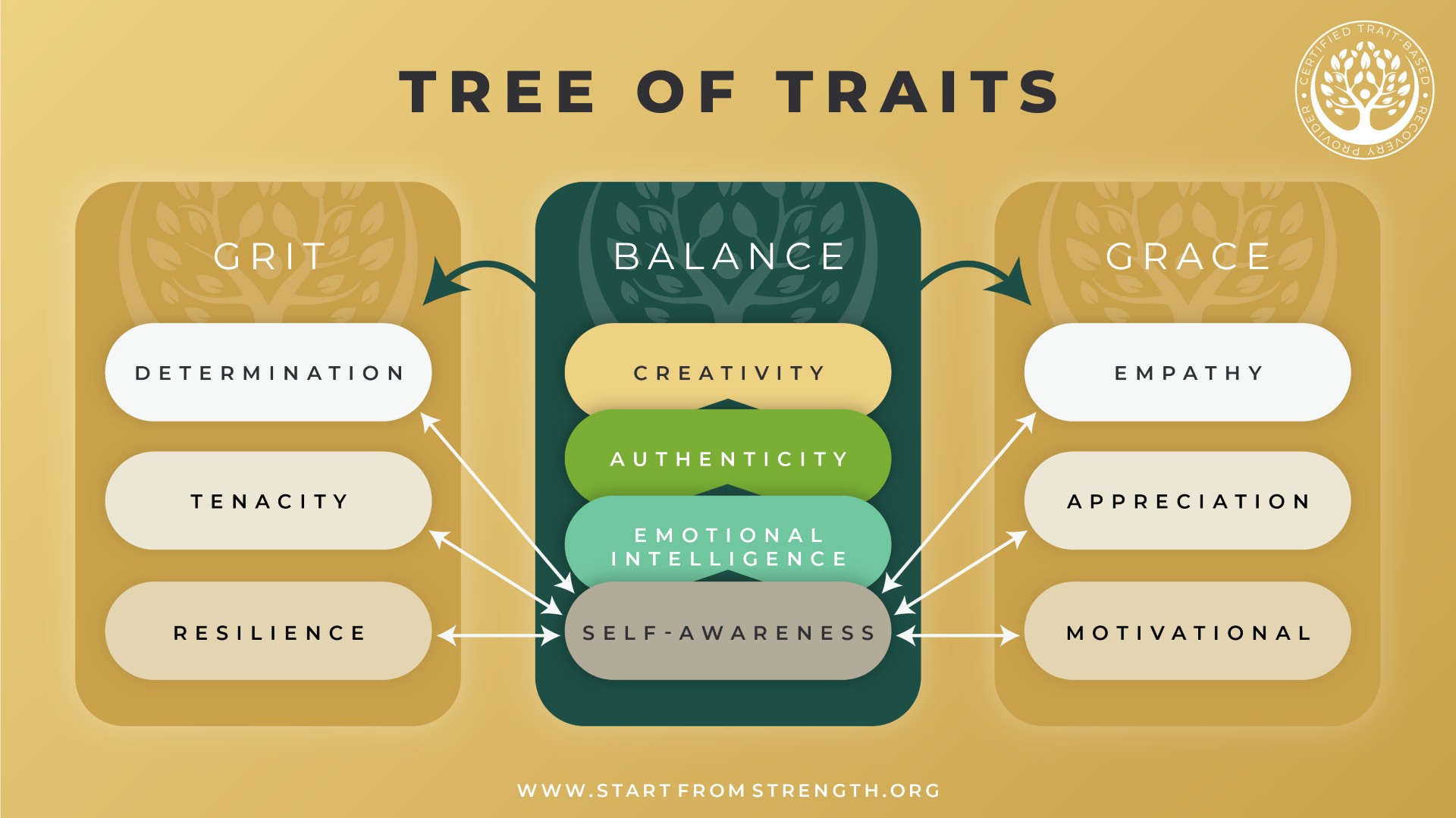
For years, I have taught Self-Awareness, Emotional Intelligence, Authenticity, and Creativity as the four Balance traits within the Trait-Based Model. I understood why each capacity mattered. I understood their relationship to Grit and Grace. But I am not sure I fully understood what the four of them were showing me about how choice develops inside a person.
Self-Awareness is where the response first becomes visible. I begin to notice what is happening within me while it is happening, not only after I have acted and am trying to explain the consequences. I can feel anger without immediately deciding that anger contains the whole truth. I can notice fear before it becomes avoidance, or shame before it persuades me to disappear.
Emotional Intelligence asks me to remain with the experience a little longer. What am I actually feeling? What happened in this moment, and what did I bring into it? Is the intensity of my response coming entirely from what is in front of me, or has this moment touched something I have felt many times before? Emotion carries information, but understanding the information is different from allowing the emotion to decide what happens next.
Then the questions become more personal.
Is the response taking shape within me consistent with who I am, or is it simply familiar? Does it reflect what I value, the relationship I want to have, and the person I am becoming? Or does it belong to fear, expectation, pain, survival, or some earlier version of me who learned to do what was necessary at the time?
That is the work of Authenticity, and it is more demanding than simply saying whatever we feel. Sometimes the response that feels most natural is not the response that is most true. Familiarity and authenticity are not the same thing. A pattern can live within us for so long that we mistake recognizing it for recognizing ourselves.
Even when I can see the pattern, understand the emotion, and recognize that the old response no longer reflects who I want to be, another problem remains. I may still have no idea what to do instead.
This is where my understanding of Creativity has changed.
I used to think of Creativity mostly through its visible expressions: art, music, writing, invention, imagination. I still think of it in those ways, but I have come to see it as something more fundamental. Creativity is also what allows a person to form a response that is not already contained in the old pattern.
If I have always withdrawn when a conversation becomes painful, remaining present is a creative act. If I have used anger to control what I could not tolerate, becoming curious about what I am afraid of is a response that had to be developed. If my identity has been built around keeping everyone pleased with me, allowing someone to be disappointed without abandoning myself requires me to do something I may never have learned to do.
At first, the new response may feel unnatural. It may even feel wrong. The familiar response has had years to establish itself as the one that keeps us safe, preserves connection, or prevents the thing we fear most. A different response will not always arrive with confidence. Sometimes it begins only as the quiet recognition that there may be another way to move through the moment.
As I followed this thought, it led me back to Grit, Grace, and Balance, and to something I believe we frequently misunderstand about strength.
Our difficulties do not always come from a lack of strength. Sometimes they come from strengths that learned an important job and continued performing it after the circumstances changed.
Determination may have carried someone through a life that would have defeated them, then begin expressing itself as control whenever uncertainty appears. Tenacity may have taught someone never to give up, then keep that person attached to a relationship, role, or belief long after remaining has become harmful. Resilience may be the reason a person survived, while also making it almost impossible to acknowledge exhaustion or ask for help.
The same is true of Grace. Empathy can help us enter another person’s experience, but without Balance it can become difficult to know where their experience ends and ours begins. Appreciation can preserve loyalty and gratitude while making it harder to admit that something we once valued no longer belongs in our lives. The ability to motivate others can become so closely connected to identity that we begin accepting responsibility for decisions that only they can make.
The trait is not false because its expression has become costly. The person is not defective. But the pattern needs to become visible.
This is why Balance cannot mean standing calmly somewhere between Grit and Grace. Balance is active. It is the growing ability to recognize which traits are present in a particular moment, what they are trying to accomplish, and whether their current expression belongs to the situation in front of us or to a situation that has already passed.
I have started referring to this as Present Trait Awareness.
Instead of beginning with “What is wrong with me?” I can ask, “What is happening within me right now?” What part of me has stepped forward? What is it trying to protect, preserve, avoid, or accomplish? When did I begin responding this way, and what would become possible if this trait did not have to perform the same old job?
These are not questions I arrived at only through study. I can see them throughout my own experience with addiction and recovery.
For a long time, I understood my addiction primarily through behavior. I used drugs. The behavior was destructive, and stopping it was necessary. There is no reason to romanticize that or make it more complicated than it was. My life could not begin to change while that behavior continued controlling it.
But stopping the behavior did not, by itself, explain why it had become so powerful. It did not explain why something that was steadily taking freedom away from me could still feel, in certain moments, like the only place freedom could be found.
What looked from the outside like a desire to use carried much more beneath it. I wanted relief. I wanted escape. I wanted belonging, autonomy, agency, and some experience of being able to step outside a life I did not know how to inhabit. I was not trying to surrender my freedom. I was trying to feel free, and I kept returning to a response that offered that feeling briefly while gradually taking almost every real freedom I had.
Recovery had to become more than the removal of that response. If nothing developed in its place, then pain, shame, anger, loneliness, and uncertainty would continue leading toward a door I was no longer supposed to open.
I had to learn what to do with pain besides escape it. I had to discover that shame could be examined without allowing it to send me into hiding, that anger could carry information without being given control of my behavior, and that uncertainty could be experienced without trying to control every person and outcome around me. I had to learn that loneliness could be answered through connection rather than through whatever had relieved it before.
The old response did not suddenly become unimaginable. Other responses gradually became possible.
That distinction is important. I do not experience recovery only as the fact that I stopped doing something. I experience it in the capacity I have developed to remain present, understand more of what is happening within me, and take part in deciding what happens next.
Once I recognized that process in recovery, I began seeing it everywhere.
It is present in a leader who begins to notice that urgency repeatedly becomes control, and who learns to remain responsible without attempting to manage every person in the room. It is present in a parent who recognizes that fear is speaking more loudly than the child in front of them. It is present in the person who has always withdrawn during conflict and begins to understand that silence and peace are not necessarily the same thing. It is present when someone who has spent a lifetime caring for others discovers that having a boundary does not make them unkind.
The circumstances are different, and the consequences are different, but something similar is happening beneath each one. A familiar response becomes visible. The person begins to understand what it has been carrying. They consider whether it still reflects who they are and what the present moment requires. Then, often without certainty and sometimes without much confidence, they try something that was not available to them before.
This is what I have been trying to understand about the relationship among Self-Awareness, Emotional Intelligence, Authenticity, and Creativity. They do more than provide language for understanding ourselves. Together, they help create the internal conditions in which choice becomes possible.
The past does not disappear when that happens. Understanding a pattern does not remove all of its force, and learning another response does not mean we will never return to the familiar one. Human development is rarely that orderly. But once the pattern can be seen and another response can be formed, the old response no longer has to arrive as the only possible ending.
Perhaps this is the form of freedom I have been trying to name. It is not freedom from everything that has happened to us, or freedom from every emotion, fear, impulse, and memory we would rather not carry. It is the growing ability to meet the present without requiring the past to decide what we do next.
And in that understanding, behavior is no longer the whole story. It is an outcome, a visible expression of the trait perception, recognition, balance, and development taking place beneath it. What we do still matters, but behavior becomes more understandable, and more capable of change, when we can recognize what is giving rise to it.
The architecture of freedom may be invisible, but perhaps it is an architecture we have always carried within us and will continue to carry wherever we go in life. It is strengthened each time we become aware of what is happening within us, understand what the moment is asking of us, and discover that the past does not have to make the next decision. For now, that is the clearest way I know to describe the architecture of freedom.
